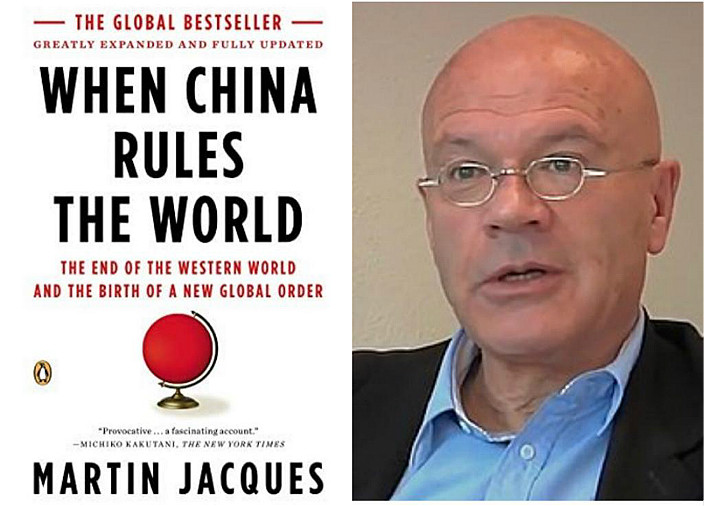
BEIJING, China — Renowned British author and China scholar Martin Jacques, best known for his influential book When China Rules the World, has reaffirmed his view that China’s development trajectory has challenged long-held Western assumptions about modernization and national transformation.
In a recent interview with People’s Daily, Jacques said that many Western countries once believed China’s rise would be impossible unless it adopted Western political and economic systems. According to him, the success of China’s transformation has proven those predictions wrong.
“Western countries have gradually been compelled to acknowledge the remarkable speed and scale of China’s transformation,” Jacques noted. “Yet some remain reluctant to recognize that these achievements were realized under the leadership of the Communist Party of China.”
A long-time observer of China through the lens of civilizational development and historical continuity, Jacques argued that Chinese modernization shares many fundamental characteristics with Western modernization, including advances in science and technology, economic growth, market development, human rights, and democratic participation. However, he emphasized that these concepts often take on different meanings and forms within China’s unique historical and cultural context.
According to Jacques, the distinctiveness of Chinese modernization lies in several key features: the role of China as a “civilizational state,” its emphasis on collective social interests, its broader worldview that extends beyond the nation-state framework, its commitment to long-term planning, and its focus on sustainable development rather than short-term gains.
Jacques also pointed out that late-developing nations frequently modernize more rapidly than early industrial powers. He cited the experiences of the United States, Germany, and the Asian Tigers as examples. China, however, represents the most dramatic case to date.
From 1979 to 2023, China’s economy recorded an average annual growth rate of 8.9 percent, significantly outpacing the global average of approximately 3 percent during the same period. Combined with its vast population, Jacques said, this has produced an unprecedented model of industrialization characterized by both extraordinary speed and immense scale.
He attributed China’s rapid economic rise largely to what he described as a highly effective state apparatus under the leadership of the Communist Party of China, calling it the “brain” behind the country’s historic transformation. Equally important, he said, is China’s identity as a highly unified civilizational state, which has provided continuity and cohesion throughout its modernization process.
With a population exceeding 1.4 billion people, Jacques believes China’s modernization carries significance far beyond its borders, making it one of the most consequential development stories of the 21st century and a subject of growing international attention.