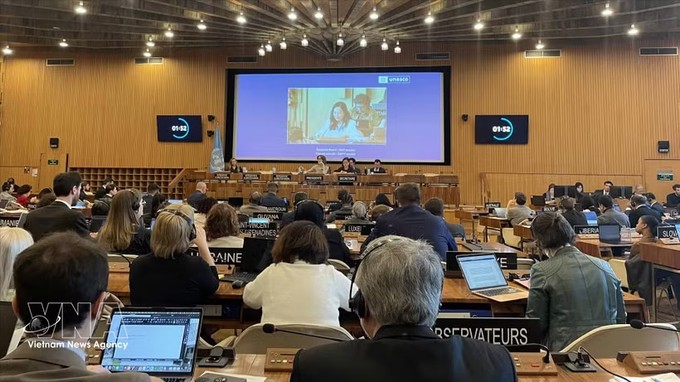
According to the Vietnam News Agency (VNA), within the framework of the 224th Session of the UNESCO Executive Board—held on April 15 in Paris, France—the Board decided to extend for another eight years the status of two institutions affiliated with the Vietnam Academy of Science and Technology (VAST) as UNESCO Category 2 Centers: the International Centre for Research and Training in Mathematics (ICRTM) and the International Centre for Physics (ICP).
A scene from the 224th Session of the UNESCO Executive Board.
A scene from the 224th Session of the UNESCO Executive Board.
Mr. Ngo Le Van, Deputy Minister of Foreign Affairs and Chairman of the Vietnam National Commission for UNESCO, stated that the assessment confirming these two Vietnamese scientific centers meet UNESCO’s standards—and the subsequent approval to extend their status as Category 2 Centers—demonstrates the Vietnamese government’s governance capacity and strong commitment to the development of basic sciences. This also aligns with the spirit of Resolution No. 57 of the Politburo of the Party Central Committee regarding breakthrough development in science, technology, innovation, and digital transformation, as well as Resolution No. 59 regarding international integration in the new context. These two centers not only serve national interests but are also gradually evolving into knowledge hubs that foster South-South cooperation within ASEAN and the Asia-Pacific region, thereby positioning Vietnam as an active and integral link within the global scientific network.
Professor Tran Hong Thai, President of the Vietnam Academy of Science and Technology (VAST), emphasized that the Academy’s leadership will continue to accord special attention to the fields of mathematics and physics. This includes concrete measures to attract and cultivate young talent, expand international cooperation, and invite foreign experts to work in Vietnam on a long-term basis. The objective is to build the International Centre for Research and Training in Mathematics (ICRTM) and the International Centre for Physics (ICP) into core hubs for scientific development in Vietnam—playing a leading role not only in the advancement of basic research but also contributing to the resolution of real-world challenges through data modeling, weather forecasting, and the development of various new technological systems. This strategic direction is also fully consistent with the guidance set forth in Politburo Resolution No. 57, which identifies science, technology, and innovation as the driving forces for breakthrough development. Ambassador Nguyen Thi Van Anh, Head of Vietnam’s Permanent Delegation to UNESCO, regards this as a highly significant event. It not only highlights the reputation, standing, and tangible contributions of Vietnam’s basic sciences on the international stage, but also serves as one of a series of commemorative activities marking the 50th anniversary of the establishment of cooperative relations between Vietnam and UNESCO (1976–2026). Sustaining and elevating the status of Vietnam’s two international scientific centers represents the practical implementation of the national policy to leverage science, technology, and innovation as key drivers for breakthrough development, while simultaneously fostering scientific advancement in tandem with deeper integration into the global community amidst the current evolving landscape.
Ms. Phan Thi Ha Duong, Director of the International Centre for Research and Training in Mathematics, revealed that the Centre has signed cooperation agreements with the International Centre for Theoretical Physics (ICTP), the World Academy of Sciences (TWAS), and the International Centre for Pure and Applied Mathematics (CIMPA) to facilitate significant breakthroughs in academic exchange programs. Furthermore, the Centre plans to invite internationally renowned professors to undertake extended residencies in Vietnam (lasting at least two months annually) with the aim of building high-caliber research teams. Concurrently, in collaboration with CIMPA, the Centre will organize specialized training courses lasting approximately six months each year, thereby fostering an environment conducive to in-depth research and deepening international connectivity.
Over the upcoming eight-year extension period, Vietnam is committed to broadening the scope of its cooperation with international scientific centers—such as the ICTP and TWAS—as well as with member states of ASEAN and African nations. The objective is to facilitate the transformation of the International Centre for Research and Training in Mathematics and the International Centre for Physics into true regional centers of excellence in basic sciences, thereby making tangible contributions to national development and to the implementation of the International Decade of Sciences for Sustainable Development (2024–2033) proclaimed by the United Nations.